
Technical development report · 26 October 2026
FGM Engine V1.0
The football logic behind the broadcast, the tactical pitch and the commentary.
FGM Engine V1.0 resolves managed matches using player positions, tactical instructions, individual attributes and remaining energy. Passes, carries, challenges and shots create a shared event record, consumed by all three match views in the app.
How a passage of play is decided
The player on the ball assesses teammates, forward progress, distance and opponents covering passing lanes. Passing instructions influence the options. A pass can reach its intended receiver, be intercepted, run out of play or trigger an offside decision.
Teammates move according to the formation and phase of play. The nearest defender responds to pressing instructions. Passing and finishing draw on the players’ original attributes; energy changes over the match and influences execution.
The decisions you can affect
| Manager’s instruction | Engine behaviour |
|---|---|
| Formation and duties | Player shape and support destinations |
| Passing style | Preferred passing distance and forward ambition |
| Pressing | Pressure on the ball and energy cost |
| Tempo | Movement, workload and shooting decisions |
| Substitutions | New player attributes and energy in the active team |
Follow the same match in three ways
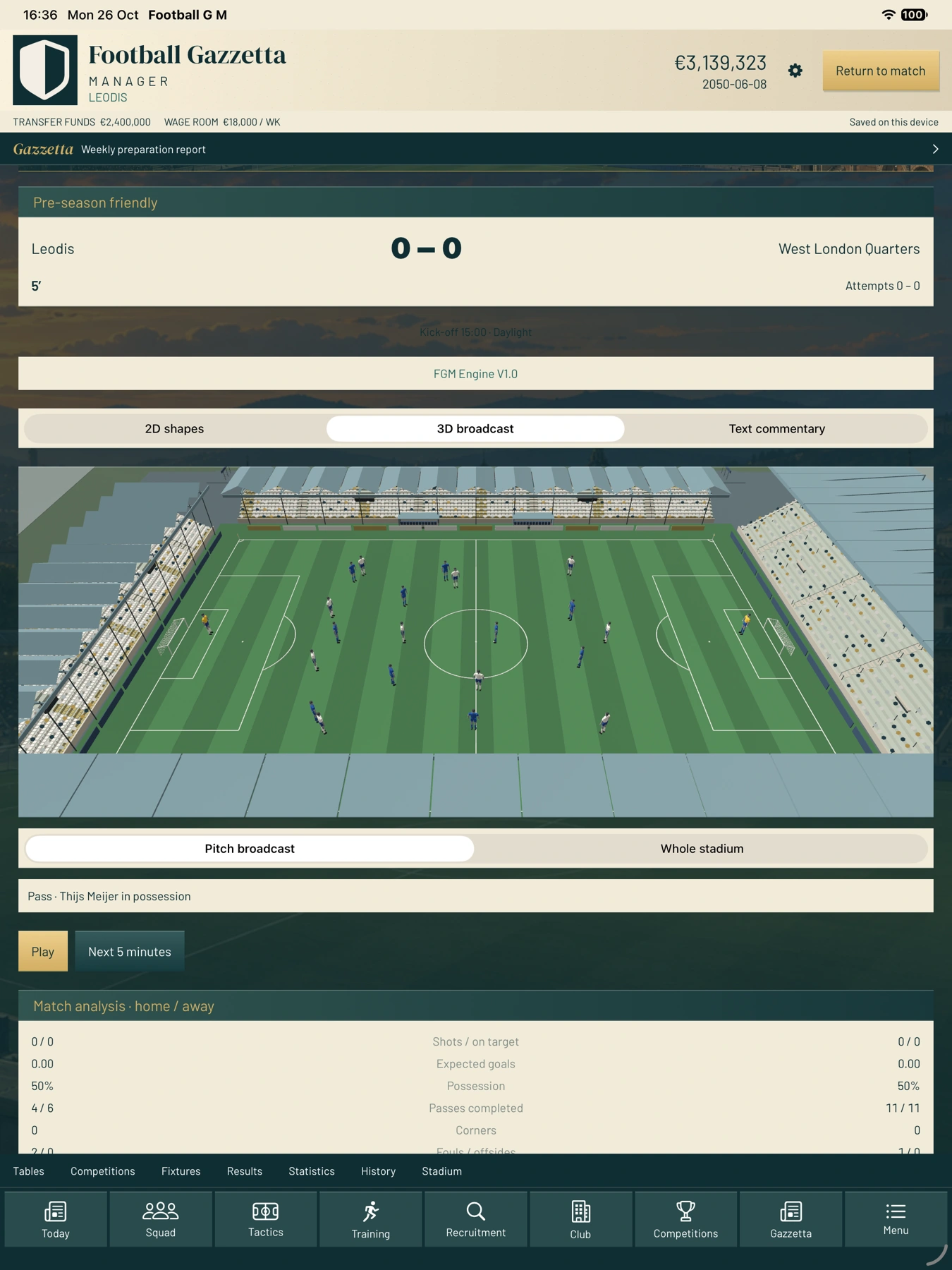
In the app, 3D and 2D read the same recorded player and ball positions. Text commentary reads the events behind those movements. Changing the view does not reroll the score, pass or shot. The still image above shows the current development app’s 3D match view. Stadium construction is demonstrated separately on the homepage.
Read what happened
Live analysis shows shots, shots on target, pass completion, possession, corners, fouls, offsides and team energy. An original expected-goals estimate considers the shooting position, angle, pressure, finishing, goalkeeper and energy. Completed managed fixtures retain their engine report.
Save and continue
The match checkpoint retains the simulation state, random streams, tactical instructions and substitution history. Automated tests compare a resumed match with uninterrupted play, and replay the same commands from the original match snapshot.
V1.0 uses discrete football decisions with animated movement between them. Continuous ball physics, a complete contact-animation library, cards, injuries, added time and open-play extra time remain further work. Background fixtures currently use a lighter simulation. The shared V1.0 presentation applies to new managed matches; matches already underway in older saves retain their original logic.
Behaviour and balance continue to be tested. This is a development engine, and the website is not an announcement that the full game is ready for sale.